














|
How SFIA works
Structure of the Framework
The framework provides a clear model for describing what ICT practitioners and users do. It is constructed as a two-dimensional matrix.
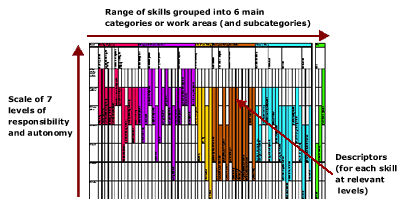 For a full scale version of the SFIA Framework Chart, please refer to the "
Copy of the Framework
" section.
For a full scale version of the SFIA Framework Chart, please refer to the "
Copy of the Framework
" section.
Skills:
One axis divides the whole of ICT into skills. Skills are grouped for convenience into subcategories or business roles. Subcategories are grouped into six categories or work areas strategy & planning, management & administration, development and implementation, service delivery, sales & marketing, and use. The SFIA structure allows a consistent approach to ICT skills across the organisation and is not limited to a specialist department.
Levels:
The other axis defines the level of responsibility and accountability exercised by ICT practitioners and users. Each of seven levels from new entrant to strategist level is defined in terms of autonomy, influence, complexity and business skills.
Descriptors:
The matrix shows the complete set of skills used by ICT practitioners and users. For each skill at each level, descriptors provide examples of typical tasks undertaken. A typical task for systems design at level 5 is reviews others' system design to ensure selection of appropriate technology, efficient use of resources, and integration of multiple systems and technology.
The matrix is not fully populated, as most roles do not require people at every level of responsibility.
Skills and Categories
Skills:
At the heart of the Framework are a set of skills currently, 54 practitioner skills and 3 user skills which together aim to describe all the abilities that are needed to deliver and exploit effective information systems.
The skills relate both to the
British Computer Societys Industry Structure Model 3
and the
e-skills NTO National Occupational Standards
(PDF file).
All the skills in SFIA are outlined in the SFIA Framework Categories publication. For further information on how to obtain this document, please refer to the "
Copy of the Framework
" section.
Categories and subcategories:
For convenience, SFIA groups sets of skills into subcategories which may relate to job roles, and groups subcategories into six categories, which may relate to functions or departments in larger organisations. SFIA describes what people do, not necessarily what their jobs are called.
As shown below, the six categories put skills into their business context.
U
S
E
|
Strategy & planning
|
|
Management & administrarion
|
|
Sales marketing
|
|
Development & implementation
|
|
Service delivery
|
Youll note that one category use is mainly concerned with the people who actually use ICT skills in their work. This category also covers the skills needed to make sure that ICT is used to improve the competitiveness and effectiveness of the business. Less obviously, the other areas also cross the boundary between the IS department and the rest of the business. This is because, increasingly, the boundaries are hard to draw and in some organisations the distinction between IS specialists and the business is fading.
Subcategories broadly align with the
British Computer Societys Industry Structure Model
. In many organisations, the SFIA subcategories align with job roles, and thus with what individuals do.
The subcategory is a way of grouping work activities, sufficiently broad but self-contained to enable staff to be positioned within the overall framework. Some individuals will only carry out some of the activities within one subcategory, others may perform them all and many people will work across more than one subcategory.
Levels of responsibility and accountability
People exercise skills at different levels. The first axis in the Framework is the division of roles into seven levels, reflecting the
-
autonomy
-
influence
-
complexity, and
-
Business skills which are typical of someone at that level.
Each level is summarised in a word or two to give a flavour. A more detailed description is in the SFIA Framework Categories publication. For further information on how to obtain this document, please refer to the "
Copy of the Framework
" section.
|
|
|
|
|

|
7: Set strategy, envision
|
|
|
|
|
|
6: initiate, influence
|
|
|
|
|
5: Ensure, advise
|
|
|
|
4: Enable
|
|
|
3: Apply
|
|
|
2: Assist
|
|
1: Follow
|
The Framework does not divide the levels into professional technical and managerial areas. Within the IS industry, these are not always meaningful distinctions.
The levels range from 1 at basic entry to 7 at a very senior level, normally in a large organisation.
Each level within each role is made up of a different combination of skills, but all roles at the same level have similar degrees of autonomy, influence and complexity, and practitioners will normally need the same kinds of business skills. A senior practitioner (level 5) in software development will have different skills from a senior practitioner in user support, but they will demonstrate similar approaches and abilities.
Individuals can be easily assigned to a level on the basis of the overall job they do; though they may have higher or lower levels in the individual skills, which make up their job.
Descriptors
For each skill at each level, descriptors provide examples of typical tasks undertaken.
A typical task for systems design at level 5 is reviews others system design to ensure selection of appropriate technology, efficient use of resources, and integration of multiple systems and technology'.
The full SFIA Framework Reference document is available directly from the e-skills NTO. For further information on how to obtain this document, please refer to the "
Copy of the Framework
" section.
|
|

|